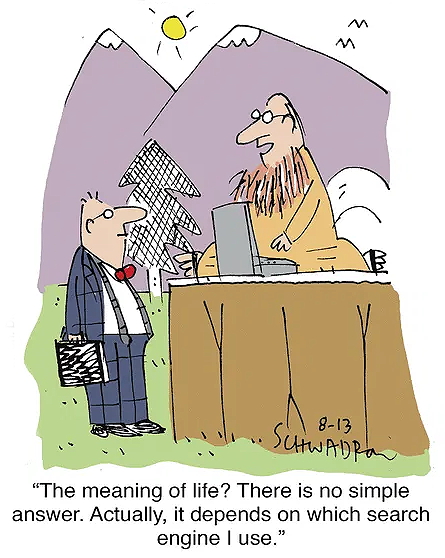
ChatGPT and Perplexity on the Meaning of Life

After yesterday’s post I of course had to ask ChatGPT and Perplexity what the meaning of life is.

ChatGPT:

That’s the grand classic, isn’t it? Philosophers, scientists, poets, and late-night college students have wrestled with it for millennia — and there’s no single answer everyone agrees on.

Here are a few main perspectives:

1. Philosophical & existential view
Existentialists like Jean-Paul Sartre and Albert Camus would say life has no inherent meaning — you create meaning yourself through your choices, relationships, and actions.

2. Religious & spiritual view
Many traditions hold that life’s purpose is to serve, love, and connect with something greater — God, the universe, or the collective good.

3. Scientific & evolutionary view
From a biological standpoint, life’s “purpose” is to survive, reproduce, and pass on genes. But humans’ big brains let us seek purposes beyond survival — like curiosity, creativity, and cooperation.

4. Humanistic & psychological view
Psychologists like Viktor Frankl suggested that meaning is found in personal responsibility, purposeful work, love, and facing suffering with dignity.

5. The lighthearted view
As *The Hitchhiker’s Guide to the Galaxy* reminds us, the answer might just be “42” — but the real fun is in figuring out the question.

If you want the practical version: the meaning of life could be to live fully, love deeply, keep learning, and leave the world a little better than you found it. The details? Those are yours to decide.

Do you want me to give you a short, inspiring “pocket version” you could keep in mind daily?

Perplexity:

There is no single, universally accepted answer to the question of the meaning of life; philosophical, religious, scientific, and personal perspectives provide many interpretations. The prevailing view among contemporary philosophers is that meaning in life is not determined by one grand cosmic factor, but is pluralistic—found in the experiences, relationships, and values an individual cultivates.[4][5] Some philosophical approaches:

Existentialism argues that life has no inherent meaning, and each individual must create their own purpose through choices, actions, and commitments.[3][4]

God-centered views propose that life’s purpose is assigned by a divine being, and meaning is found in fulfilling a role within a cosmic plan.[5]

– Many philosophers now reject the search for a single meaning and instead point to sources like loving relationships, creativity, altruism, achievement, knowledge, and moral goodness as providing meaning in life, even without an overarching purpose.[4][5]

For many, the question divides into two:

– What is the meaning of life in general (the existence of humanity or the universe)?
– What is the meaning in my life (personal fulfillment, relationships, and values)?[4]

Asking about meaning “in life” leads to practical considerations—what gives your own existence significance, purpose, and value, regardless of whether the universe itself has meaning.[4]

Pop culture and satire have addressed the question, notably with Monty Python’s comedic take, which mocks the seriousness and ambiguity of searching for a grand answer, ultimately poking fun at the idea that such meaning must be “big” or mystical.[1][6]

Most modern philosophers and thinkers advise seeking meaning through pursuits that are intrinsically valuable, unique to each person, and shaped by personal experience—rather than expecting one universal answer.[7][5][4]

[1] https://www.imdb.com/title/tt0085959/
[2] https://en.wikipedia.org/wiki/Monty_Python’s_The_Meaning_of_Life
[3] https://en.wikipedia.org/wiki/Meaning_of_life
[4] https://www.imdb.com/title/tt0085959/
[5] https://www.reddit.com/r/Existentialism/comments/qhrf9q/what_is_the_meaning_of_life_why_are_we_here/
[6] https://philosophynow.org/issues/147/Why_Youre_Probably_Wrong_About_The_Meaning_of_Life
[7] https://plato.stanford.edu/entries/life-meaning/
[8] https://www.rottentomatoes.com/m/monty_pythons_the_meaning_of_life
[9] https://yourmeaninginlife.com
[10] https://www.netflix.com/title/60029676
[11] https://www.imdb.com/title/tt0085959/
[12] https://en.wikipedia.org/wiki/Meaning_of_life
[13] https://en.wikipedia.org/wiki/Theology
[14] https://en.wikipedia.org/wiki/Consequentialism
[15] https://en.wikipedia.org/wiki/Wikipedia:Featured_article_review/Big_Bang/archive3
[16] https://en.wikipedia.org/wiki/Meaning_of_life
[17] https://en.wikipedia.org/wiki/Aesthetics
[18] https://en.wikipedia.org/wiki/Meaning_of_life
[19] https://en.wikipedia.org/wiki/Meaning_of_life
[20] https://en.wikipedia.org/wiki/Meaning_of_life
[21] https://en.wikipedia.org/wiki/Meaning_of_life

Posted in Life As a Shared Adventure | 22 Comments

The Meaning of Life

Posted in Life As a Shared Adventure | 28 Comments

Yesterday’s Post…

Brought back some great memories.

Over 30 years ago both my husband’s and my divisions were having trouble financially and there was a good chance we would both lose our jobs. Everyone was tense and worried at work, so I looked around and asked,

What’s the opportunity here?

The answer was obvious,

I could become an expert on stress management.

So I started wearing my

Life is uncertain, eat dessert first

T-shirt and started studying stress management.

Andy and I were both offered great early retirement packages, so we took them. He didn’t have any trouble finding some interesting consulting jobs, and I started teaching classes and leading groups in stress management, emotional aikido, dealing with difficult people, etc.

Since I was coming from physics and computer programming I got certified in Neuro-linguistic programming (NLP) to give myself some credentials. Yesterday reminded me of two NLP ideas/quotes,

Focus on what you want, not on what you don’t want.

If what you’re doing isn’t working, try something else.

Plus a good question when a relationship isn’t working,

How long are you going to try drinking from an empty cup and complain that you are thirsty?

Powerful ideas, well worth remembering.

.

Posted in Life As a Shared Adventure | 24 Comments

Autobiography in Five Chapters

I read this poem by Portia Nelson years ago and for some reason thought of it today. I still love it.

I
I walk down the street.
There is a deep hole in the sidewalk.
I fall in.
I am lost … I am hopeless.
It isn’t my fault.
It takes forever to find a way out.

II
I walk down the same street.
There is a deep hole in the sidewalk.
I pretend I don’t see it.
I fall in again.
I can’t believe I’m in the same place.
But it isn’t my fault.
It still takes a long time to get out.

III
I walk down the same street.
There is a deep hole in the sidewalk.
I see it is there.
I still fall in … it’s a habit.
My eyes are open.
I know where I am.
It is my fault.
I get out immediately.

IV
I walk down the same street.
There is a deep hole in the sidewalk.
I walk around it.

V
I walk down another street.

It makes me laugh every time I think of it.

Posted in Life As a Shared Adventure | 22 Comments

Twelve Years…

of daily blogging. I started blogging twice a week in 2007, but on August 14, 2013 I switched to blogging every day. (This is my 5081st total post.)

Why? Because it makes me happy. What better reason? And blogging was there for me when I broke my hip last year and spent 45 days away from home. Hurray for iPads and blogging! An important part of my life came right along with me.

Posted in Life As a Shared Adventure | 32 Comments

Dogs and Books

Posted in Life As a Shared Adventure | 24 Comments

Virtual Voice

Because of my eyestrain I listen to a lot of audible books. I was surprised when I started my last one to hear the narrator say,

This title is narrated with Virtual Voice, computer-generated narration for audio books.

I noticed afterwards that Amazon had mentioned it:

I was concerned it might be distracting, but in fact the narration is pleasant and clear. It’s easier to listen to and understand than some of my other audio books. Good for them!

Posted in Life As a Shared Adventure | 32 Comments

Play Your Part Well…

and let go of the results. I was interested in philosophy when I was in high school, and I decided life was uncertain and that phrase was the only thing that made sense to me. It came from both the Hindu Bhagavad Gita and Marcus Aurelius, the Roman Stoic emperor.

It’s a fine sentiment, but not always easy to do. So I was chuffed last week when I spent hours and hours dealing with my mobile phone company (I will spare you the details) and managed to stay cheerful and patient through the whole process. Truth be told, I’ve been getting a lot of exercise patting myself on the back about it.

Then I was curious. What would ChatGPT and Perplexity say about the phrase?

ChatGPT:

That sounds like a wise reminder—one that echoes the teachings of many philosophical and spiritual traditions.

“Play your part well and let go of the results” means:

  • Focus on your effort, not the outcome.
    Do your best with what’s in your control—your actions, your integrity, your intention.
  • Release attachment to how things turn out.
    You can’t force the future, and obsessing over results creates anxiety and limits presence.
  • Trust the process.
    Like in Stoicism: “Do your duty; leave the rest to fate.”
    Like in the Bhagavad Gita: “You have the right to the work, not to the fruits of the work.”

Perplexity:

The phrase “play your part well and let go of the results” expresses a profound philosophical approach to life, work, and relationships. It carries several layers of meaning:

  1. Focus on Effort, Not Outcome
    It encourages you to devote yourself fully to the tasks at hand—to act with diligence, integrity, and care—without becoming attached to or anxious about the outcomes. Your responsibility lies in what you can control: your actions, intentions, and attitude.
  2. Acceptance and Surrender
    Once you have done your best, the results are often shaped by factors beyond your control. Letting go means accepting that uncertainties and external influences exist. This attitude helps reduce stress and disappointment, fostering peace of mind.
  3. Philosophical Roots
    This idea resonates with spiritual and philosophical teachings—such as the “karma yoga” of the Bhagavad Gita, which advises acting dutifully without attachment to the fruits of action. It’s echoed in Stoicism, which teaches focusing on what you can control and accepting what you cannot.
  4. Practical Application
    At work: Do your best on a project, then accept the feedback or the outcome, good or bad.
    In relationships: Be honest and present; you can’t control how others respond.
    Personal goals: Give your best effort, embrace growth, and let go of rigid expectations about results.

Benefits
Reduces anxiety and perfectionism.
Builds resilience and adaptability.
Encourages living in the present moment.

Summary: Play your part well—meaning act responsibly, with effort and integrity—and let go of the results, trusting that you’ve done your best and whatever comes next is for you to accept and learn from. It’s a formula for peace, personal growth, and a balanced life.

They both understood what the phrase means and the connection to the Bhagavad Gita and Stoicism. How cool is that?!

Posted in Life As a Shared Adventure | 20 Comments

Action Relieves Anxiety (Perplexity AI)

I gave Perplexity. the same prompt, and this is how it responded:

Taking specific actions such as regular exercise, deep breathing, mindfulness meditation, and structured problem-solving can effectively relieve anxiety.[1][2][3][4][5][6]
Key actions supported by research and expert guidelines include:

  • Deep breathing exercises: Techniques like diaphragmatic or “box” breathing can quickly reduce anxiety symptoms by activating the body’s relaxation response.[4][7][8][1]
  • Physical activity: Regular movement, such as walking, running, dancing, or yoga, decreases stress hormones and helps process anxious energy.[3][9][5][6][1]
  • Mindfulness and meditation: Practicing awareness and acceptance of the present moment through meditation has been shown to lower anxiety.[5][10][1][4]
  • Structured routines and self-care: Maintaining a predictable daily routine and engaging in self-care activities (adequate sleep, balanced meals, limiting screen time) provides emotional stability.[3][5]
  • Journaling: Writing thoughts and feelings can help to process anxiety and gain perspective.[1][3]
  • Challenging anxious thoughts: Learning to recognize and reframe irrational worries supports long-term anxiety relief.[9][4]
  • Social support: Talking about your feelings with friends, family, or a counselor can help reduce anxiety.[2]
  • Spending time with pets or in nature: Both are associated with lower levels of stress and improved mood.[3]
  • Professional support and therapy: Cognitive-behavioral therapy (including exposure therapy) and, in some cases, medication can provide long-term solutions for persistent anxiety.[9][1]

Even a small, intentional action—like a one-minute breathing exercise or taking a brief walk—can significantly diminish acute anxiety by restoring a sense of control and calming both mind and body.[7][11][4]

[1] https://www.mayoclinichealthsystem.org/hometown-health/speaking-of-health/tips-to-help-ease-anxiety
[2] https://www.nhs.uk/mental-health/feelings-symptoms-behaviours/feelings-and-symptoms/anxiety-fear-panic/
[3] https://www.mdanderson.org/cancerwise/anxiety-hacks–7-tools-to-manage-stress-and-worry-in-the-moment.h00-159537378.html
[4] https://www.healthline.com/nutrition/16-ways-relieve-stress-anxiety
[5] https://www.betterhealth.vic.gov.au/health/conditionsandtreatments/anxiety-treatment-options
[6] https://allonehealth.com/5-actions-to-alleviate-anxiety-quickly/
[7] https://www.youtube.com/watch?v=McCDfP5M878
[8] https://www.mayoclinichealthsystem.org/hometown-health/speaking-of-health/9-ways-to-tame-anxiety-during-the-covid-19-pandemic
[9] https://www.mind.org.uk/information-support/types-of-mental-health-problems/anxiety-and-panic-attacks/self-care/
[10] https://www.health.harvard.edu/mind-and-mood/recognizing-and-easing-the-physical-symptoms-of-anxiety
[11] https://www.dignityhealth.org/central-california/locations/stjosephs-stockton/about-us/hello-healthy/hello-healthy-articles/31-surprising-things-that-reduce-anxiety-fast
[12] https://www.ceelycounseling.com/action-cures-anxiety

Posted in Life As a Shared Adventure | 29 Comments

Action Relieves Anxiety (ChatGPT)

I gave ChatGPT that prompt and it said:

Yes — action relieves anxiety is a powerful and often true statement.

When you’re anxious, you’re usually stuck in your head — worrying about future possibilities, ruminating over past events, or overwhelmed by uncertainty. Action brings you into the present. It gives your mind something to focus on and your body something to do, which can break the cycle of anxious overthinking.

Here’s why action helps:

1. Shifts focus – Doing something concrete, even small, pulls attention away from anxious thoughts.
2. Restores a sense of control – Anxiety often comes from feeling helpless. Taking action gives you agency.
3. Builds momentum – One small step leads to another, which can reduce paralysis.
4. Engages the body – Physical movement can regulate stress hormones and calm the nervous system.

Examples of helpful actions:

  • Making a to-do list
  • Going for a walk
  • Cleaning a drawer
  • Calling a friend
  • Writing things down
  • Taking one small step on a project you’ve been avoiding

Important caveat:

Not all action is helpful — some actions are avoidance in disguise. The key is intentional, constructive action aligned with your values or goals.

Tomorrow I will post how Perplexity AI responded.

Posted in Life As a Shared Adventure | 20 Comments