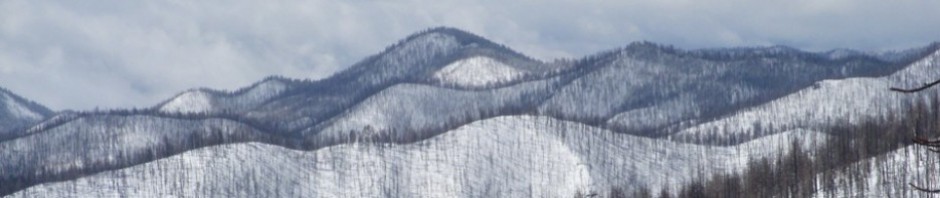
Yesterday the snow melted right away up on the land, too. The deer were no doubt pleased.


As you can see, Andy doesn’t need a lawn mower.
March 13, 2018
Yesterday the snow melted right away up on the land, too. The deer were no doubt pleased.
As you can see, Andy doesn’t need a lawn mower.
We had a little bit of snow last night, but most of it melted before I left for Silver Sneakers shortly after 10 a.m. There is still snow on the hood of the car and on the windshield.

I took the above quick snapshot with my iPod Touch. Here it is cropped in a photo editor to zoom in on the area of interest.

We don’t have smart phones, so as part of continuing education I bought the iPod Touch to see what the camera could do. I was impressed that such a little device (4.86″ by 2.31″ by 0.24″) can take a fair picture.
When I got home I took another picture using the zoom function:

Not a bad picture!
You can see the snow has melted — notice in particular the snow behind the dark car across the parking lot. Spring must be here!
Cathy’s comment on my last post was right on, we need to teach kids how to think and do things, not just pass tests. That reminds me of Kaitlin coming home, from 5th grade when she was 10, as I recall, telling me a simple bookcase put together with interlocking slots had fallen down. She had to put it back together because no one else, including the teacher, could do it. She said, “Because I was the only one who knew how to THINK!”
I had to laugh. The poor kid was raised hearing Andy’s, “Smart people are a dime a dozen. You have to learn to be effective. You have to learn to think!”
I think it was the following year she came home saying she had watched a boy struggling with some insulated wire. He kept accidentally cutting through it, so she said, “It looks like you’re trying to strip the insulation off that.” He was amazed. She was the first girl he had ever known who knew about things like that. She said, “If you had led the life I lead! Have you ever built a tractor?”
The land was a great place to raise a child. We bought it when Kaitlin was 7 years old and we lived down here in this apartment, but we spent our weekends and holidays up there (when we weren’t snowed out) working on projects together — growing gardens and fruit trees and building sheds, an outhouse, barbed wire fences, a tractor from a kit, etc.
Here are three of the earliest pictures I have of her working up there. She and Andy are wiring up the pump for the well.


And here are two of her with the famous tractor:


That’s why when the place burned down in 2011 we decided not to use the insurance money to go elsewhere but to stay and rebuild. Too many family memories to give the place up.
We’ve all probably read articles saying kids are too sheltered and protected these days, so I think it’s encouraging that some educators in Britain are trying to do something about it.
Out went the plastic playhouses and in came the dicey stuff: stacks of two-by-fours, crates and loose bricks. The schoolyard got a mud pit, a tire swing, log stumps and workbenches with hammers and saws.
“We thought, how can we bring that element of risk into your everyday environment?” said Leah Morris, who manages the early years program at the school in Shoeburyness in southeast Britain. “We were looking at, O.K., so we’ve got a sand pit, what can we add to the sand pit to make it more risky?”
Now, Ms. Morris says proudly, “we have fires, we use knives, saws, different tools,” all used under adult supervision. Indoors, scissors abound, and so do sharp-edged tape dispensers (“they normally only cut themselves once,” she says).
Limited risks are increasingly cast by experts as an experience essential to childhood development, useful in building resilience and grit.
—In Britain’s Playgrounds, ‘Bringing in Risk’ to Build Resilience
Good for them! I hope it goes well and the idea spreads for the sake of the kids.
My first reaction to this cartoon yesterday, while I was doing laundry and working on income tax, was feeling glad I didn’t have to travel to Europe, that I could just enjoy my day here.
Having been there in the past probably makes a difference. Andy I don’t like to travel any more, but we lived in France for 13 months right after he got his Ph.D. and we got married. He worked at Orsay, and we lived in Paris for the first month while we were waiting for an apartment in Orsay. Even then I took the 30-minute train ride into Paris most weekdays.
Then even earlier memories came flooding back, especially how it all started. I was sitting finishing up a problem set in a physics classroom when four of the fellows in my class came over and sat next to me, two on either side. They said, “Hey, Jean, how would you like to go to Stanford in Germany with us?” It sounded crazy and I had to finish my homework and turn it in before the class started, so I brushed them off. But after class they explained — physics majors didn’t usually go because of the course load, but it would be for the last two quarters of our junior year, and we could finish our Electricity and Magnetism course as independent study over there. I’m a sucker for independent study, so I was in.
Unfortunately, only four of us got accepted, not enough for the independent study idea, and two of the fellows decided it would mean a horrendous course load our senior year, so they dropped out. The other fellow switched his major to math and was still going. I had been fairly isolated when I was a kid so did a lot of studying to keep myself from going bonkers, but I had always wanted to have some adventures. So I decided common sense was overrated and went too.
It was a great experience, with a lot of traveling around Europe, and even though my senior year was challenging, I remember being more happy and excited than scared and exhausted. It worked out fine and I was happy about my choice.
I worked at the High Energy Physics Lab at Stanford that summer before going to graduate school, and that’s where I met Andy. I went down to La Jolla for graduate school for one semester, but I spent my spare time reading literature and taking a break from physics, so I decided to drop out and return to Palo Alto to get a job and save some money for more traveling. Andy had always worked and saved and had $4000 that he wanted to spend traveling around the world. That sounded good to me, so by the time he graduated I could match his $4000. He had been offered a one-year position at Orsay where they were just starting their linear accelerator, so we decided to use that as a home base while we traveled around Europe. We spent half our money there, the other half coming back the long way.
That was over 50 years ago, and we’re so glad we had a chance to do it when the exchange rate was so favorable, places were a lot less crowded, and traveling was more fun. I still have fond memories of flying, and I’m not about to spoil them by getting on a plane now.
I agree with Pig, I’m having a great time in my everyday life. I also hope modern day travelers are enjoying themselves in spite of the hassles.
In a move that can only be described as utterly Canadian, hundreds of doctors in Quebec are protesting their pay raises, saying they already make too much money.
As of Wednesday afternoon, more than 700 physicians, residents and medical students from the Canadian province had signed an online petition asking for their pay raises to be canceled. A group named Médecins Québécois Pour le Régime Public (MQRP), which represents Quebec doctors and advocates for public health, started the petition Feb. 25.
“We, Quebec doctors who believe in a strong public system, oppose the recent salary increases negotiated by our medical federations,” the petition reads in French.
The physicians group said it could not in good conscience accept pay raises when working conditions remained difficult for others in their profession — including nurses and clerks — and while patients “live with the lack of access to required services because of drastic cuts in recent years.”
—Hundreds of Canadian doctors demand lower salaries. (Yes, lower.)
How cool is that? What a spirit lifter — I’m grinning from ear to ear!
The headline for an express.co.uk article was Hate exercise? There’s a pill for that: Scientists invent drug that REPLACES working out
Yeah, sure. Inside the article it says,
It might be used as a substitute for exercise in the elderly, or as an aid to get people into an exercise program.
“But what we really don’t see is this drug providing an alternative for those people who just can’t be bothered exercising.”
Even the well-researched New Yorker article on the subject overpromised with the headline,
A Pill to Make Exercise Obsolete —
What if a drug could give you all the benefits of a workout?
The article was full of information, and the parts I liked best were
Mice love to run, Evans told me, and when he puts an exercise wheel in their cage they typically log several miles a night. These nocturnal drills are not simply a way of dealing with the stress of laboratory life, as scientists from Leiden University, in the Netherlands, demonstrated in a charming experiment conducted a few years ago. They left a small cagelike structure containing a training wheel in a quiet corner of an urban park, under the surveillance of a motion-activated night-vision camera. The resulting footage showed that the wheel was in near-constant use by wild mice. Despite the fact that their daily activities—foraging for food, searching for mates, avoiding predators—provided a more than adequate workout, the mice voluntarily chose to run, spending up to eighteen minutes at a time on the wheel, and returning for repeat sessions. (Several frogs and slugs also made use of the amenity, possibly by accident.)
and, later in the article,
Instead of designing a pill to replace exercise in humans, Garland favors a different pharmaceutical solution. “Personally, I’ve been more interested in the possibility of drugs that would make us more motivated to exercise,” he said.
The Guardian’s headline was less sensational and closer to the truth:
‘Exercise pill’ could deliver benefits of fitness in tablet form — Drug could transform lives of those who are unable to exercise because of obesity or serious physical disability, mouse study suggests
This headline would have been more accurate if it had said “some of the benefits” rather than just “benefits”, but at least it was pointing out the pill isn’t for everyone, and the article does mention potential problems with the pill.
So, as usual, we have to keep our brains plugged in, especially when reading headlines designed to grab our attention.
Rummuser’s post about traffic reminds me of how lucky I am to live in a place where there is little traffic. Because of my eyes for years I have driven only around town, and even then when the traffic is especially light. Now I sometimes have to drive home from Andy’s eye appointments in Santa Fe, but even that isn’t bad. We try to avoid rush hour traffic, and even though we have to go through the town, we have very few lane changes. It’s nothing like these videos of traffic in India and other places.
https://youtu.be/Uz5uxAsrbwI
Another reason to count my blessings!


