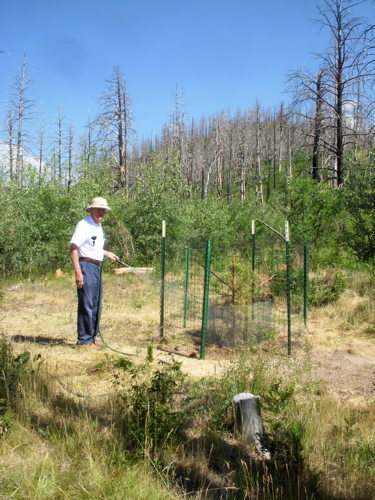
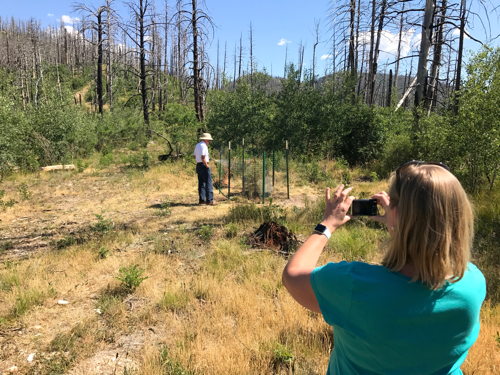
Water your trees! These trees originated at a time when the earth was warmer and wetter than it is today. Once the soil surrounding the roots of the giant sequoias totally dries out these trees are dead. They are not at all forgiving to those who forget to water, like most landscape trees are. On hot summer days your newly planted giant sequoias will consume all available water within twenty four hours. The roots of the container grown trees are confined into a relatively small area. Initially you must water directly into the root ball because the roots have not spread wide enough to consume water from the surrounding soil. You must be diligent with your watering at least until the roots have grown out to where they can pick up enough rainwater and subsurface water on their own. When irrigating think consistently moist soil and not consistently muddy. For the best results continue to irrigate your trees for their entire lifetime (about 3000 years). If this isn’t possible, ask someone to water them in your absence or put in an automatic irrigation system. Remember that water is critical!
—Giant Sequoias in the Landscape Garden
We had a good trip up to the land with Kaitlin, Torben and the pups yesterday. They’ll be staying up there until Thursday evening.
I was hoping to write this post up there, but my laptop wouldn’t work right. Kaitlin searched the web with her iPhone and found some things for me to try, so I eventually got it restored. Patience and persistence, plenty of chances to practice. So I wrote this post when I got back home.
Here are some pictures Kaitlin sent when they were on their way. The funny thing is it looks as if the pups were crowded together in the back seat. In fact, they were in the Tesla and there was plenty of room to spread out. Presumably they liked it that way and they got along fine.
Rummuser has been writing about memory triggers from time to time. Andy, Beate and Tim’s latest Sunday walk reminded me of all the hiking I did about 30 years ago. The highlight was when I finished a business trip in Hamburg on a Friday afternoon and had to be at a conference in Graz, Austria on Tuesday.
For years Andy’s father had been giving us Alpine calendars for Christmas, so what I really wanted to do in the three days I had was to go to somewhere where I could see the Alps and take some walks. Garmisch-Partenkirchen was the perfect spot. I was a bit concerned that at that time no one spoke English, but I still remembered enough German to get by.
As luck would have it, it had rained for the previous two weeks but cleared up just before I arrived. That meant the air was crystal clear when I got there Saturday morning. (I had taken the night train from Hamburg to Munich, then a local train on to Garmisch-Partenkirchen.) I stored my bags in a locker at the train station, then headed for the Zugspitze, the highest mountain in Germany — with views of Germany, Austria, Italy and Switzerland on clear days like the one I had.
I did the tourist thing and climbed up to the top from the restaurant, of course. The path was slippery — the rocks had been polished by all the countless tourists using the trail — but it was safe, and fun.
On the way down I stopped at the lake (Eibsee) and walked partway around, then finished the trip to the valley and went back to the train station to get my bags then on the hotel to check in.
The next day I walked a few miles on a pleasant back road to Partnachklaam (the Partnach Gorge):
The Partnach Gorge, or Partnachklamm, is a “don’t miss” attraction on any visit to the Bavarian alpine resort of Garmisch-Partenkirchen.
The gorge, which acts as a natural conduit for the Partnach River, runs 700 meters or 2,305 feet between limestone walls that reach 80 meters (262 feet) high. A series of galleries and tunnels has been carved out of the rock along one side, allowing visitors to walk along the rushing river and duck behind waterfalls.
https://youtu.be/MfdlkBx3dIo
After I finished that walk I walked down the hill to catch a bus to the Alpspitzbahn — a cable car with spectacular views of the Alpspitz and other mountains.
I looked at the views from the top station of the cable car, then took a leisurely walk down through alpine meadows to another cable car that took me back down to the valley. I later calculated I must have walked about 15 miles that day, so I did manage to take a walk!
Monday morning I boarded the train to Graz and on the way saw the Austrian Alps and pastoral views of rural Austria. That was definitely one of the highlights of my life, so thanks, Rummuser, Beate, Tim and Andy, for triggering the memory. 🙂
Today is Asteroid Day, the anniversary of the 1908 Tunguska event:
June 30, 1908 In a remote part of Russia, a fireball was seen streaking across the daytime sky. Within moments, something exploded in the atmosphere above Siberia’s Podkamennaya Tunguska River in what is now Krasnoyarsk Krai, Russia.
This event – now widely known as the Tunguska event – is believed to have been caused by an incoming asteroid (or comet), which never actually struck Earth but instead exploded in the atmosphere, causing what is known as an air burst, three to six miles (5–10 kilometers) above Earth’s surface.
The explosion released enough energy to kill reindeer and flatten trees for many kilometers around the blast site. But no crater was ever found.
—Today in science: Tunguska explosion
The idea of Asteroid Day is to increase awareness of asteroids so we can track them and do something if one becomes a threat to the earth. And, of course, to possibly turn them into something useful. This video proposes a seemingly wild idea, but who knows? One thing is certain, I won’t be around if it ever happens.