The Meaning of Life

Rummuser’s latest post quotes Robert Fulghum’s All I Really Need To Know I Learned in Kindergarten. It reminded me of my favorite Fulghum essay, from It Was On Fire When I Lay Down On It:

“Are There Any Questions?” An offer that comes at the end of college lectures and long meetings. Said when an audience is not only overdosed with information, but when there is no time left anyhow. At times like that you sure do have questions. Like “Can we leave now?” and “What the hell was this meeting for?” and “Where can I get a drink?”

The gesture is supposed to indicate openness on the part of the speaker, I suppose, but if in fact you do ask a question, both the speaker and audience will give you drop-dead looks. And some fool — some earnest idiot — always asks. And the speaker always answers. By repeating most of what he has already said.

But if there is a little time left and there is a little silence in response to the invitation, I usually ask the most important question of all: “What is the meaning of life?”

You never know, somebody may have the answer, and I’d really hate to miss it because I was too socially inhibited to ask. But when I ask, it’s usually taken as a kind of absurdist move — people laugh and nod and gather up their stuff and the meeting is dismissed on that ridiculous note.

Once, and only once, I asked that question and got a serious answer. One that is with me still.

First, I must tell you where this happened, because the place has a power of its own. In Greece again.

Near the village of Gonia on a rocky bay of the island of Crete, sits a Greek Orthodox monastery. Alongside it, on land donated by the monastery, is an institute dedicated to human understanding and peace, and especially to rapprochement between Germans and Cretans. An improbable task, given the bitter residue of wartime.

This site is important, because it overlooks the small airstrip at Maleme where Nazi paratroopers invaded Crete and were attacked by peasants wielding kitchen knives and hay scythes. The retribution was terrible. The populations of whole villages were lined up and shot for assaulting Hitler’s finest troops.

High above the institute is a cemetery with a single cross marking the mass grave of Cretan partisans. And across the bay on yet another hill is the regimented burial ground of the Nazi paratroopers. The memorials are so placed that all might see and never forget. Hate was the only weapon the Cretans had at the end, and it was a weapon many vowed never to give up. Never ever.

Against this heavy curtain of history, in this place where the stone of hatred is hard and thick, the existence of an institute devoted to healing the wounds of war is a fragile paradox. How has it come to be here? The answer is a man. Alexander Papaderos.

A doctor of philosophy, teacher, politician, resident of Athens but a son of this soil. At war’s end he came to believe that the Germans and the Cretans had much to give one another — much to learn from one another. That they had an example to set. For if they could forgive each other and construct a creative relationship, then any people could.

To make a lovely story short, Papaderos succeeded. The institute became a reality — a conference ground on the site of horror — and it was in fact a source of producive interaction between the two countries. Books have been written on the dreams that were realized by what people gave to people in this place.

By the time I came to the institute for a summer session, Alexander Papaderos had become a living legend. One look at him and you saw his strength and intensity — energy, physical power, courage, intelligence, passion, and vivacity radiated from this person. And to speak to him, to shake his hand, to be in a room with him when he spoke, was to experience his extraordinary electric humanity. Few men live up to their reputations when you get close. Alexander Papaderos was an exception.

At the last session on the last morning of a two-week seminar on Greek culture, led by intellectuals and experts in their fields who were recruited by Papaderos from across Greece, Papaderos rose from his chair at the back of the room and walked to the front, where he stood in the bright Greek sunlight of an open window and looked out. We followed his gaze across the bay to the iron cross marking the German cemetery.

He turned. And made the ritual gesture: “Are there any questions?”

Quiet quilted the room. These two weeks had generated enough questions for a lifetime, but for now there was only silence.

“No questions?” Papaderos swept the room with his eyes.

So. I asked.

“Dr. Papaderos, what is the meaning of life?”

The usual laughter followed, and people stirred to go.

Papaderos held up his hand and stilled the room and looked at me for a long time, asking with his eyes if I was serious and seeing from my eyes that I was.

“I will answer your question.”

Taking his wallet out of his hip pocket, he fished into a leather billfold and brought out a very small round mirror, about the size of a quarter.

And what he said went like this:

“When I was a small child, during the war, we were very poor and we lived in a remote village. One day, on the road, I found the broken pieces of a mirror. A German motorcycle had been wrecked in that place.

“I tried to find all the pieces and put them together, but it was not possible, so I kept only the largest piece. This one. And by scratching it on a stone I made it round. I began to play with it as a toy and became fascinated by the fact that I could reflect light into dark places where the sun would never shine — in deep holes and crevices and dark closets. It became a game for me to get light into the most inaccessible places I could find.

“I kept the little mirror, and as I went about my growing up, I would take it out in idle moments and continue the challenge of the game. As I became a man, I grew to understand that this was not just a child’s game but a metaphor for what I might do with my life. I came to understand that I am not the light or the source of light. But light — truth, understanding, knowledge — is there, and it will only shine in many dark places if I reflect it.

“I am a fragment of a mirror whose whole design and shape I do not know. Nevertheless, with what I have I can reflect light into the dark places of this world — into the black places in the hearts of men — and change some things in some people. Perhaps others may see and do likewise. This is what I am about. This is the meaning of my life.”

And then he took his small mirror and, holding it carefully, caught the bright rays of daylight streaming through the window and reflected them onto my face and onto my hands folded on the desk.

Much of what I experienced in the way of information about Greek culture and history that summer is gone from memory. But in the wallet of my mind I carry a small round mirror still.

Are there any questions?


Posted in Life As a Shared Adventure | 11 Comments

It Was Worth It

This fellow broke the law when he rescued his dog from a fire. He’s charged with two misdemeanors, but it was worth it.


Posted in Life As a Shared Adventure | 2 Comments

Customer Reviews

Our microwave oven, where we do most of our cooking, gave up the ghost, so I was looking at the reviews of possible replacements — four stars or above.

Of course, not all five star reviews are as helpful as others. How long did the reviewer above have the oven? Why buy this one rather than another?

Some four and five star reviews do give useful information about the appliance, but some, like the one above, seem suspicious. I glance through them, but the ones I pay attention to are the three stars and below — they warn of possible problems and keep us from becoming too optimistic. Anyway, we’ve made our decision and will keep our fingers crossed. Unless the thing starts a fire (apparently a possible hazard of microwave ovens), it’s not a big deal in the grand scheme of things.

Do you pay attention to customer reviews?


Posted in Life As a Shared Adventure | 11 Comments

Persistence Pays

That makes more sense than Tempi with the sod.

If you like pictures of dogs and their kitten best friends, click here.


Posted in Life As a Shared Adventure | 8 Comments

It’s a Different World

The food was nearly gone and the bills were going unpaid, but they still had their pills, and that was what they thought of as the sky brightened and they awoke, one by one. First came Kathy Strait, 55, who withdrew six pills from a miniature backpack and swallowed them. Then emerged her daughter, Franny Tidwell, 32, who rummaged through 29 bottles of medication atop the refrigerator and brought down her own: oxcarbazepine for bipolar disorder, fluoxetine for depression, an opiate for pain. She next reached for two green bottles of Tenex, a medication for hyperactivity, filled two glasses with water and said, “Come here, boys.”

The boys were identical twins William and Dale, 10. They were the fourth generation in this family to receive federal disability checks, and the first to be declared no longer disabled and have them taken away. In days that had grown increasingly tense, as debts mounted and desperation grew to prove that the twins should be on disability, this was always the worst time, before the medication kicked in, when the mobile home was filled with the sounds of children fighting, dogs barking, adults yelling, television volume turned up.
—The Washington Post, Generations, Disabled

The article is about one of the hundreds of thousand families with more than one member receiving disability payments. In this case the twins had been receiving disability payments because they had been born prematurely, but now they had been taken off. The family tried to get them declared autistic, but had no luck.

So now the grandmother, adult daughter and four children have to live on only $2005 a month, plus food stamps and other help, instead of the previous $3133. The interesting part to me is they spend a total of $433 a month for cable TV ($98), cell phones ($300), and internet ($35). It’s a different world from the one I grew up in.


Posted in Life As a Shared Adventure | 20 Comments

Don’t Blink

https://m.youtube.com/watch?v=RDl7VE8xL8c

I love the expression on the judges’ faces.


Posted in Life As a Shared Adventure | 9 Comments

What Do You Got?

Do you, or anyone you know, use the term, “What do you got?” I’ve been hearing it for several years now in police procedurals like NCIS and Hawaii 5-0, and it still grates on me. So I looked it up to see if anyone else is bothered by it.

Someone asked,

I recognise this as an American construction which sounds strange to me — Brits invariably say either “What have you got?” or “What do you have?”. But I’d be interested to know if it’s considered “normal” by most/all Americans, or if it’s regionally or otherwise restricted.

And here were some of the answers:

“What do you got” is used frequently in American shows such as NCIS and just about any procedural police show. I’m Australian and it grates for me too.

I’m American, native New Yorker, and for me the expression “What do you got?” is sooooo off! I just googled it after reading it in a novel written by a Bree Wolf (Remember Me), who I believe is British.

As an American raised just north of NYC (not far enough north to not know a lot of Yiddish), “Whaddaya got?” sounds very normal to me, sorta maybe Bronx-ish?

I’m now watching the Australian TV series The Dr. Blake Mysteries, and they don’t use “do you got?” but instead say, “What have you got?” That still gets my attention. To me “What do you have?” sounds better.

TV as a cultural experience. As well as an exercise aid.


Posted in Life As a Shared Adventure | 8 Comments

New Evergreens

Yesterday we said we won’t have another mixed-conifer forest in our or Kaitlin and Torben’s lifetime. We can see why from these pictures of some Ponderosa pines and fir trees that Beate and Tim gave Andy and helped him plant.

These fir trees and pines were planted five years ago:

A fir tree:

We can see from this closeup that this fir tree is about 20″ tall now:

A Ponderosa pine tree:

As we can see from this closeup, this pine is almost 4′ high now:

Here’s a closeup of another Ponderosa pine planted the same time. It is less than 2′ high:

This one had problems, first about three years ago it was nibbled on by some critters, then this last winter it was hit by a falling tree and lost some branches. Life is not easy up there.

This fir tree was planted last year:

We can see from the closeup that it’s about 11″ high:

In the past Beate and Tim planted about 1000 trees on their land, and so far about 200 of them have survived and are growing. And they planted 20 more pines and 20 more firs this year. Again, it will be a long time before there is a forest up there.


Posted in Life As a Shared Adventure | 6 Comments

Heart of Darkness?

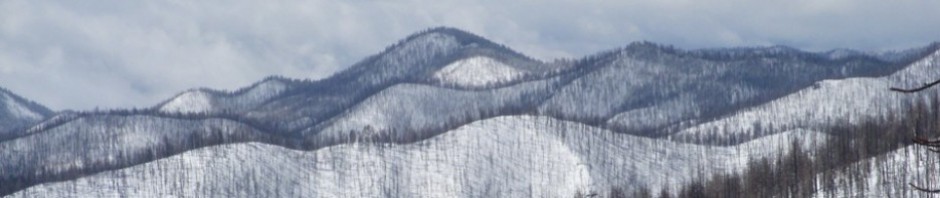
Tens of thousands of acres of forests are gone from the Jemez Mountains. In our warming world, they won’t grow back, and the evidence of that was clear today.
—The Heart of Darkness: A walk through the scorched landscapes where our forest used to be and a glimpse of our future fires

Andy thinks this article is unduly pessimistic because the evergreens that Beate, Tim, and he have planted seem to be doing well. He’s going to take a picture of a Ponderosa pine that is several feet tall by now. So far they’ve been watering the planted trees regularly, but Andy plans to stop soon.

On the other hand, even with suitable weather (no guarantees there with climate change) the beautiful forest that burned in the Las Conchas fire won’t be back in our lifetimes, or in Kaitlin and Torben’s either.

June 26, 2011:

September 8, 2011:

No sense getting depressed. As usual, doing the best we can with what we have left.


Posted in Life As a Shared Adventure | 8 Comments

50 Life Lessons

To celebrate growing older, I once wrote the 45 lessons life taught me.

It is the most-requested column I’ve ever written. My odometer rolls over to 50 this week, so here’s an update:

1. Life isn’t fair, but it’s still good.

2. When in doubt, just take the next small step.

3. Life is too short to waste time hating anyone.

4. Don’t take yourself so seriously. No one else does.

5. Pay off your credit cards every month.

6. You don’t have to win every argument. Agree to disagree.

7. Cry with someone. It’s more healing than crying alone.

8. It’s OK to get angry with God. He can take it.

9. Save for retirement starting with your first paycheck.

10. When it comes to chocolate, resistance is futile.

11. Make peace with your past so it won’t screw up the present.

12. It’s OK to let your children see you cry.

13. Don’t compare your life to others’. You have no idea what their journey is all about.

14. If a relationship has to be a secret, you shouldn’t be in it.

15. Everything can change in the blink of an eye. But don’t worry; God never blinks.

16. Life is too short for long pity parties. Get busy living, or get busy dying.

17. You can get through anything if you stay put in today.

18. A writer writes. If you want to be a writer, write.

19. It’s never too late to have a happy childhood. But the second one is up to you and no one else.

20. When it comes to going after what you love in life, don’t take no for an answer.

21. Burn the candles, use the nice sheets, wear the fancy lingerie. Don’t save it for a special occasion. Today is special.

22. Overprepare, then go with the flow.

23. Be eccentric now. Don’t wait for old age to wear purple.

24. The most important sex organ is the brain.

25. No one is in charge of your happiness except you.

26. Frame every so-called disaster with these words: “In five years, will this matter?”

27. Always choose life.

28. Forgive everyone everything.

29. What other people think of you is none of your business.

30. Time heals almost everything. Give time time.

31. However good or bad a situation is, it will change.

32. Your job won’t take care of you when you are sick. Your friends will. Stay in touch.

33. Believe in miracles.

34. God loves you because of who God is, not because of anything you did or didn’t do.

35. Whatever doesn’t kill you really does make you stronger.

36. Growing old beats the alternative – dying young.

37. Your children get only one childhood. Make it memorable.

38. Read the Psalms. They cover every human emotion.

39. Get outside every day. Miracles are waiting everywhere.

40. If we all threw our problems in a pile and saw everyone else’s, we’d grab ours back.

41. Don’t audit life. Show up and make the most of it now.

42. Get rid of anything that isn’t useful, beautiful or joyful.

43. All that truly matters in the end is that you loved.

44. Envy is a waste of time. You already have all you need.

45. The best is yet to come.

46. No matter how you feel, get up, dress up and show up.

47. Take a deep breath. It calms the mind.

48. If you don’t ask, you don’t get.

49. Yield.

50. Life isn’t tied with a bow, but it’s still a gift.

—Regina Brett

Do you especially agree with any of these? Do you disagree with some? Are there any you would like to add?

I especially like #22, “Overprepare, then go with the flow,” and #47, “Take a deep breath. It calms the mind.”


Posted in Life As a Shared Adventure | 16 Comments