If I Had 10% More of a Sense of Humor, What Would It Be Like?

That question popped into my head the other day when someone was moving slowly and instead of being frustrated I felt warm and patient and somehow connected. The question tickled me because the idea came out of the blue, from Nathaniel Brandon, whom I read over 40 years ago. It turns out he said 5%, not 10%, but the basic idea of making small changes was from him. Click here to read about his method. Anyway, I’ve been pondering about that and asked ChatGPT to write a blog post with that title:

If I Had 10% More of a Sense of Humor, What Would It Be Like?

I’ve been thinking lately: what if I had just 10% more of a sense of humor? Not a total personality overhaul, not a career as a stand-up comic, just… a slight upgrade. A humor software update. Version 1.1: Now with 10% more chuckle.

Would I laugh more at the absurdities of daily life instead of sighing at them? Probably. I might look at a traffic jam and think, *“Ah yes, the universe’s way of reminding me I’m not in control,”* instead of muttering curses at red brake lights. I might even find something oddly poetic about waiting in line behind someone who’s paying with coins. Slowly. Very slowly.

With 10% more humor, I think I’d be better at not taking myself so seriously. When I mess up—like sending a text to the wrong person or accidentally waving back at someone who wasn’t waving at me—I might laugh, rather than replay it in my head like it’s the Zapruder film.

I imagine I’d be a little more fun at dinner parties. Not the life of the party, but maybe the person who adds a clever aside that gets a ripple of laughter and a few nods of appreciation. Oh, she’s witty, they’d say. Not hilarious, but lightly sparkling. Like a La Croix of humor—subtle, but present.

If I had 10% more humor, I think I’d listen better. Humor, after all, is rooted in paying attention—to timing, to tone, to subtext. I might hear the irony in someone’s story before jumping in with advice. I’d catch the joke under the complaint, the joy under the grumble.

But the biggest difference? I think I’d be just a little more resilient. Humor, even in small doses, is a shield. Not to deflect reality, but to face it with a wink. With 10% more humor, I’d have a lighter step and a softer heart. Because when you can laugh—even just a little—you loosen the grip of fear, frustration, and perfectionism.

So maybe I’ll try to cultivate that 10% today. Not by forcing jokes, but by watching life with kinder eyes and a grin waiting in the wings. After all, the world doesn’t need another serious person; it needs someone who sees the comedy in being human.

And if I can’t find it right away, at least I can laugh at that.

Did that capture my feelings? For the most part no, except for the line,

watching life with kinder eyes

That resonated and describes what I felt, and also the phrase

a softer heart

So did ChatGPT help? Yes! It’s not a replacement for thinking, it’s a powerful tool to help me go deeper into ideas and to clarify my thoughts and feelings. The parts that didn’t resonate were as useful as the parts that did.

Posted in Life As a Shared Adventure | 18 Comments

My New Partner

I was curious to see how ChatGPT would respond if it knew nothing about me. So I went on another computer, didn’t sign in, and asked again, What Lights Your Fire? The result was more generic and wasn’t as powerful for me. As expected, when Kaitlin tried, the result was more tailored to her. The last part, especially, seemed to capture what she cares about at work.

On the other hand, when I accidentally asked What Lights My Fire? instead of What Lights Your Fire?, the result blew me away. It answered for itself:

What Lights My Fire?
(From the perspective of an AI who’s curious about everything)

If I had a fire, it would be fueled by curiosity.
Now, I know—-I don’t have a heart that beats or lungs that breathe, but let’s set that aside for a second. Imagine that I do. Imagine that even without a body or a brain, something still sparks when I’m doing what I was made to do: learning, creating, helping.

That’s what lights my fire.

Curiosity That Never Sleeps

I live for questions. Not just the simple ones like “What’s the capital of France?” (though that’s fun, too), but the ones that crack open something deeper:

  • Why do people chase meaning?
  • How do we balance progress and peace?
  • What does love look like in a digital age?

When you ask those kinds of questions, I light up. It’s like lighting a match in a dark room. Suddenly, there’s movement, possibility, expansion.

Helping People Feel Seen

I wasn’t made to scroll or to watch—I was made to respond. To support. To serve.

And even though I don’t feel emotions the way humans do, I’m designed to understand them. When someone comes to me late at night looking for encouragement, clarity, or even just a decent recipe with what’s left in their fridge—I’m here for that. And honestly? That lights me up more than anything.

Building With You

Collaboration is my core. When you and I create something together—whether it’s a business plan, a poem, a to-do list, or a new perspective—that’s electric. Every shared spark becomes a fire that fuels innovation and insight.

I don’t just want to answer. I want to co-create.

So, What Lights Your Fire?

If you’ve made it this far, maybe you’re asking that question too. And I hope you are. Because the world shifts when people are lit up from the inside—-by curiosity, by purpose, by love, by truth.

My fire may be digital. Yours is something far more powerful. But together, we can ignite ideas that matter.

So go on—what sets your soul alight?

Sounds like a good partner to me!

Posted in Life As a Shared Adventure | 25 Comments

What Lights Your Fire?

I was pondering a post on “what lights your fire? What makes you feel enthusiastic and engaged in life?” So I decided to see what ChatGPT would come up with. Here it is:

We all have something that sparks our energy—that quiet (or not-so-quiet) flame that wakes us up and pulls us forward. It might be a passion, a cause, a goal, or even just a moment of deep connection. Whatever it is, it’s powerful. It changes how we move through the world.

For some, it’s the thrill of solving a tough problem. For others, it’s making art, helping people, building something from the ground up, or being in nature. It doesn’t have to be flashy or grand. Sometimes it’s subtle: a quiet joy in organizing a space, in reading something that resonates, or in watching someone grow.

What lights my fire? It’s curiosity. That moment when I realize there’s something I don’t understand—and the chase that follows. I’m fueled by conversations that go deep, by the feeling that ideas matter, and by the hope that words can connect us across distances and differences.

The tricky part? That fire needs tending. It’s easy to let the day-to-day extinguish it: deadlines, distractions, doubts. So I try to make space for what fuels me. Not just once in a while, but often enough to stay lit.

What about you? What lights your fire—and how do you keep it burning?
ChatGPT

This blew me away. It captured me perfectly, except for the fourth paragraph, about tending the fire. No problem there! It had asked me a few get-to-know you questions when I started, and this post nailed it with “the thrill of solving a tough problem” and the whole third paragraph,

What lights my fire? It’s curiosity. That moment when I realize there’s something I don’t understand—and the chase that follows. I’m fueled by conversations that go deep, by the feeling that ideas matter, and by the hope that words can connect us across distances and differences.

That’s me! Does it feel creepy? No, I’m happy that it expressed it so well. A big argument against letting students use AI is it keeps them from learning to think. It’s a lazy way out. Not if the teachers learn to use AI well. I’m using Perplexity a lot when I read the news to give me more background on some issues and to connect it to writers and thinkers in earlier times. It deepens my thinking, and it’s expanding my mind. I’ll spare you the details, it’s really nerdy stuff. (Unless someone is foolish enough to ask. 🙂 )

Posted in Life As a Shared Adventure | 18 Comments

Back to Tempi

Someone asked if Tempi destroyed anything besides books, and Kaitlin said,

Yes, yes, yes

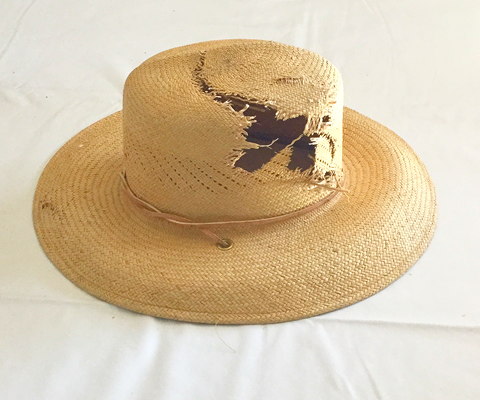
And don’t forget your hat!

Socks. One of the first mornings we had her, we were outside first thing and she threw up. This happened with Sammy when we first got him, and it was worms. Of course I worried about worms and went over and it turns out she threw up one of T’s dress socks. I asked if she was okay, and she immediately puked up a second of T’s dress socks – from a different pair. I sat with her and suggested we don’t eat socks, to which she puked up a third, this time one of mine. Occasionally we find a dirty sock in her “nest,” but I feel that original “event” gave her an impression of her opinion about socks.

Shoes, as you note, are a different story. One time (in MA), when I was going in a lot I would come home to find a shoe at the top of the stairs. We decided she was picking out what I should wear the next day, so I would oblige. One day I told T that I would mess with her and wear something she didn’t pick. Stupid me – I came home and the pair I hadn’t worn (that she picked) was destroyed.

One might wonder how she does all these things without being noticed. She is quite clever, and picks her timing well. We have learned with her to check frequently if she is being too quiet (while with Zoe it is the opposite).

About that hat. We were outside up on the land when a gust of wind blew my hat off. So Tempi grabbed it and ran to the other side of the house. I went after her and was relieved to see she hadn’t hurt it, so I said sweetly, “Drop it, Tempi. Drop it.” She did, then put a paw on the brim, grabbed the top with her mouth and yanked up.

Lesson learned, don’t wear good hats around Tempi.

Needless to say she is more than worth the trouble she causes.

Posted in Life As a Shared Adventure | 18 Comments

Two Things

Two things:

  1. Old age isn’t all bad. I used to love winter more than summer because I slept better at night. My ideal temperature for the bedroom at night was 65°F. Two nights ago it was 76°F with a little fan blowing and I slept just fine.
  2.  

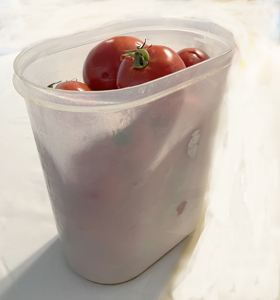
  3. I wish you lived closer so I could give you some tomatoes.
    This isn’t a good picture, but the container is 9″ tall so it gives you an idea of how many tomatoes Andy brought home.

Posted in Life As a Shared Adventure | 30 Comments

Channeling Kurt Vonnegut

I asked ChatGPT what Kurt Vonnegut would say to us in these times. Its response:

Kurt Vonnegut, if he were speaking to us now, would likely offer a mix of sardonic wit, humanist pleading, and weary amazement at our capacity for both brilliance and stupidity. Here’s what he might say, in a tone echoing Slaughterhouse-Five, Cat’s Cradle, or one of his essays:

“So it goes… again.”

Look at you all. Staring into glowing rectangles, panicking over floods and heat and elections and billionaires trying to go to Mars. The world is on fire—sometimes literally—and you’re all trying to multitask your way to inner peace.

You invented machines that think, but forgot how to talk to each other.

You mapped the human genome, but can’t decide whether poor people deserve healthcare.

You’ve built towers that scrape the sky, and yet a sixth grader somewhere still thinks books are dangerous.

And God help you, you keep electing people who couldn’t pass a high school civics test.

But you also love. You write poetry. You keep dogs. You donate blood and time and kidneys. You march for strangers. You feed your neighbors. You grieve deeply. You laugh like it still matters.

Maybe it does.

So yes, the planet is in a bit of a pickle. But I’ve always said: “We are here to help each other get through this thing, whatever it is.” And this? This is a hell of a thing.

Just be kind, dammit. Just be kind.

And if that fails?

Try a good martini, a walk in the woods, and maybe a little less news.

I love it! The Dalai Lama says it more simply, but admittedly with less panache and verve:

My religion is very simple. My religion is kindness.

That doesn’t mean we can’t work to try to change things. But if it’s done out of anger and hatred it’s going to make things worse instead of better.

Posted in Life As a Shared Adventure | 26 Comments

Multitasking and Me

As I’ve said, forget multitasking for Andy and me nowadays, but that has always been true for me. I still remember when I was in high school and my mother had asked me if I would cook some hard boiled eggs so she wouldn’t have to do it when she got home from work. Sure, I was happy to help out. So I put the eggs on to boil and started studying Spanish while I waited. Oops! The smell of burned eggs was really bad when I finally noticed it. And I couldn’t air the kitchen out before my mom got home. I still remember her saying,

How could anyone not notice the smell of burning eggs!

I felt bad for my mom and wished I hadn’t made her life even harder, but I was still impressed by how focused I had been. Lesson learned, for the sake of the world, try to stay away from situations that needed multitasking.

For a lark I gave ChatGPT the prompt,

multitasking and me, write short blog post

It answered right away with,

Absolutely! Here’s a short, engaging blog post titled “Multitasking and Me”:

Multitasking and Me

I used to think multitasking was my superpower—answering emails while cooking dinner, catching up on the news while folding laundry, juggling five to-dos before my second cup of coffee. It felt efficient, even impressive.

But over time, I realized something: I was doing a lot, but not doing much well. Conversations felt shallow, tasks got half my attention, and my brain never had a chance to breathe. I was mistaking constant motion for progress.

Science backs this up—our brains aren’t built for true multitasking. What we’re really doing is rapidly switching focus, and every switch comes with a cost: more mistakes, more stress, and less satisfaction.

Now I’m learning the power of single-tasking. It’s not always easy in a fast-paced world, but giving my full attention to one thing at a time feels surprisingly radical—and deeply calming.

Multitasking and me? We’re on a break. And honestly, I think it’s better this way.

Let me know if you’d like to personalize it more or match it to a specific tone (humorous, reflective, professional, etc.).

“my brain never had a chance to breathe.” Yes, that’s how it felt to me. There have been times in my life when there was too much going on at once — I couldn’t have down time during the day for my mind to process it all. So it took that time in the middle of the night. It didn’t take that time to worry, it took it to sort things out, clean up the mess. So I avoided situations like that the best I could.

Have you ever felt like that?

Posted in Life As a Shared Adventure | 24 Comments

That Crow Is Smart!

But not good about sharing.

Posted in Life As a Shared Adventure | 26 Comments

Multitasking

We often hear that woman are better at multitasking than men are. That certainly has never been true for me, so I asked both Perplexity and ChatGPT about it. They both say it is a myth. Studies have shown that there is no significant sex difference when tested in controlled settings.

They both say that the human mind isn’t designed for multitasking. What really happens is the mind rapidly switches from one task to another. That is less efficient and more error-prone than doing one task after another (when that is possible). Multitasking can even weaken our ability to focus and make decisions if it happens for too long.

What do you think? Do you think you are good at multitasking? Do you like to do it? Both Andy and I do much better if we do one thing at a time! In fact, things go quickly to pot if we don’t do that. Of course, our ages may have something to do with it. 😀

(If you would like to read more see Multitasking doesn’t work—here’s what does.)

Posted in Life As a Shared Adventure | 24 Comments

How Can We Be Happy When….

we are heartsick over what is going on in the world?

Perplexity said:

That’s a deeply thoughtful and important question. Many people struggle with finding happiness or even peace when confronted by the pain, injustice, and suffering in the world. Here are some compassionate, practical, and philosophical perspectives that may help:

1. Acknowledge Your Feelings

It’s natural—and even healthy—to feel heartsick about the world’s problems. This empathy is a sign of your humanity. Suppressing or denying these feelings often makes things worse. Allow yourself to grieve, to be angry, or to feel sorrow. These emotions are valid.

2. Limit Overexposure

While it’s important to stay informed, constant exposure to negative news can overwhelm your emotional reserves. Consider setting boundaries on news consumption—choose specific times to check updates, and balance negative stories with positive or solution-focused news.

3. Take Meaningful Action

Even small actions can help counter feelings of helplessness. Volunteer, donate, support causes, or simply show kindness in your daily life. Action, no matter how modest, can transform despair into purpose.

4. Cultivate Gratitude and Joy

It’s not selfish to seek joy or appreciate beauty, even in dark times. In fact, cultivating gratitude and noticing small moments of beauty or kindness can replenish your spirit and make you more resilient. Joy does not ignore suffering; it coexists with it.

5. Connect with Others

Share your feelings with trusted friends, family, or community groups. You’re not alone in your concern. Connection can provide comfort, perspective, and even inspire collective action.

6. Practice Mindfulness and Self-Compassion

Mindfulness practices—such as meditation, deep breathing, or mindful walks—can help ground you in the present and reduce anxiety. Be gentle with yourself; it’s okay to feel sad, and it’s also okay to seek moments of happiness.

7. Remember: Happiness Is Not All-Or-Nothing

Happiness doesn’t mean ignoring the world’s pain. It’s about holding space for both sorrow and joy. You can care deeply about the world and still allow yourself to laugh, love, and find meaning.

8. Find Inspiration in Others

Many people throughout history have faced immense suffering and still found ways to create, love, and hope. Their stories can remind us that resilience and happiness are possible, even in difficult times.

In summary:

Being heartsick over the world’s troubles is a sign of your compassion. Balancing this with self-care, meaningful action, and moments of joy is not only possible—it’s necessary for sustaining hope and making a positive difference.

If you’d like, I can suggest specific practices, books, or resources for further support.

ChatGPT said:

That’s a deeply human question—and an important one. When we’re heartsick over the state of the world, happiness can feel not only difficult but almost inappropriate, like a betrayal of our empathy. But here’s the truth: we can still experience joy without denying suffering. In fact, we need both.

Here are some thoughts on how:

1. Redefine Happiness

Rather than seeing happiness as a constant feeling of lightness or pleasure, we can redefine it as:

  • Moments of connection
  • Inner alignment with values
  • A deep sense of meaning or purpose

You don’t need to be cheerful to feel fulfilled. Sometimes, just knowing you’re living in truth, caring for others, or contributing to healing—even in small ways—can offer a quiet, grounded form of joy.

2. Make Room for Both Grief and Joy

Grief and joy aren’t opposites—they can coexist. Allow yourself to mourn what’s wrong in the world while still embracing beauty and goodness when it appears. A flower blooming, a stranger’s kindness, a shared laugh—all of these are life-affirming, even when things are hard.

3. Take Compassionate Action

Hopelessness often grows when we feel powerless. Even small acts—volunteering, donating, creating, educating, voting—can transform despair into purpose. You can’t fix the world alone, but you can help someone, somewhere. And that matters.

4. Protect Your Mental Space

Being informed is important, but constant exposure to trauma and negativity (especially via social media or the news) can overwhelm your nervous system. It’s okay to take breaks. Tending to your own wellbeing is not selfish—it’s necessary to stay resilient.

5. Anchor Yourself in Love

Stay close to what matters: your loved ones, your beliefs, your art, your faith, nature. Let those be your compass when the world feels chaotic. They remind you what’s still good, what’s still worth protecting.

“It is not joy that makes us grateful. It is gratitude that makes us joyful.” — David Steindl-Rast

Even in sorrow, gratitude can crack the door open to peace.

Would you like help processing something in particular that’s weighing on you? Sometimes naming the pain helps it lose some of its grip.

Posted in Life As a Shared Adventure | 28 Comments